Defining the Best AI Video Generator: Architectural Insights into Modern Video Production
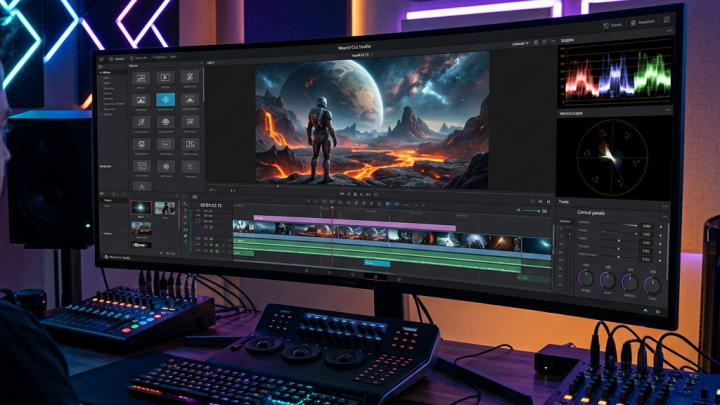
The landscape of digital media is undergoing a profound transformation driven by rapid advancements in generative artificial intelligence. For decades, producing high-fidelity video content required extensive technical expertise, significant financial resources, and prolonged post-production cycles. Today, software systems are abstracting these complexities, allowing creators to generate cinematic sequences directly from text prompts. At the center of this industry shift is Neural4D, an innovative platform jointly developed by Nanjing University, DreamTech, Oxford University, and Fudan University. This robust academic and commercial collaboration has yielded a system that fundamentally redefines the technical benchmarks for automated video creation.
When evaluating the best AI Video Generator, professionals look beyond basic text-to-pixel capabilities. The true measure of a production-ready tool lies in its ability to maintain strict temporal consistency, ensure photorealistic lighting, and offer granular control over camera dynamics. By leveraging advanced latent diffusion models and spatial-temporal processing, modern platforms are replacing fragmented, flickering outputs with broadcast-quality motion graphics and live-action simulations. This deep technical integration is setting a new standard for how marketing teams, film studios, and independent digital artists approach their creative pipelines.
Resolving Temporal Inconsistency in Generative Video
The most significant hurdle in the early days of generative video was the lack of frame coherence. Early models treated video generation as a series of independent image generation tasks. This approach resulted in severe flickering, where the textures, lighting, and even the geometry of the subjects would shift aggressively from one frame to the next.
Modern architectures solve this by implementing spatial-temporal attention mechanisms. Instead of processing frames in isolation, the neural network evaluates a comprehensive block of frames simultaneously. The network learns to track the trajectory of individual pixels across the timeline, ensuring that a shadow cast in frame one accurately moves and morphs through frame thirty.
This mathematical continuity guarantees that complex physical interactions, such as water splashing or fabric tearing, adhere to consistent physical laws throughout the generated sequence. The elimination of visual flickering is what elevates a standard machine learning experiment into a viable commercial rendering tool.
The Role of Advanced Rendering Architectures
Beyond basic motion, a top-tier video generator must synthesize realistic environments. This requires a deep understanding of three-dimensional space and lighting physics. The underlying architecture of the most effective platforms utilizes concepts derived from Neural Radiance Fields (NeRF) and advanced volume rendering techniques.
When a user inputs a prompt describing a dimly lit cyberpunk street, the system does not merely paint a flat two-dimensional canvas. Instead, it calculates a theoretical 3D volumetric space. It determines the position of light sources, the reflectivity of the wet asphalt, and the atmospheric density of the fog. By calculating these variables in three dimensions before projecting them into a two-dimensional video format, the software achieves photorealistic depth of field and accurate motion blur.
This architectural depth is particularly important when simulating dynamic camera movements. Whether the prompt calls for a sweeping drone shot, a rapid zoom, or a slow cinematic pan, the volumetric calculation ensures that the parallax effect is mathematically flawless, providing a sense of scale and realism that traditional 2D diffusion models simply cannot replicate.
Internal System Specifications and Performance Metrics
To fully grasp the capabilities of a high-end generative platform, it is helpful to review the specific performance parameters that drive the generation process. The following table outlines the core technical specifications and processing benchmarks of the primary Neural4D video generation pipeline.
| Technical Parameter | Specification / Benchmark |
|---|---|
| Maximum Output Resolution | 4K UHD (3840 x 2160 pixels) |
| Target Frame Rate | 24, 30, and 60 FPS options |
| Temporal Coherence Window | 120 continuous frames per batch |
| Core Architecture | Latent Spatial-Temporal Diffusion |
| Average Rendering Time (1080p) | 45 to 90 seconds per scene |
| Native Aspect Ratios | 16:9, 9:16, 1:1, 4:3 |
These metrics demonstrate a system engineered for high-throughput commercial application. The ability to render native 4K resolution at 60 frames per second directly from a text prompt allows production studios to drastically compress their post-production timelines, moving from concept ideation to final render in minutes rather than weeks.
The Future Trajectory of Automated Video Production
The integration of advanced neural architectures into video generation platforms is accelerating the democratization of high-end media production. By solving critical issues like temporal consistency and introducing volumetric light calculation, these systems are proving to be indispensable assets for professional creators. The continuous refinement of processing speeds and output resolutions ensures that generative video will transition from a supplementary tool to the foundational core of digital content creation. As these technologies evolve alongside robust community resource networks, the boundary between technical limitation and creative expression will completely dissolve, enabling a new era of highly dynamic, automated visual storytelling.